
How Work-Related Angst Is Silently Sabotaging Your Performance

BY ERIN EATOUGH & SHONNA WATERS
Originally Published on Fractional Insights
In today's business landscape, organizations face an invisible threat that's costing Fortune 1000 companies hundreds of millions annually. New research from Fractional Insights has identified a phenomenon called "work-related angst" that affects nearly half of all employees and directly undermines organizational performance.
The Hidden Performance Drain
Our groundbreaking study of 1,000 U.S. employees across industries reveals that workplace psychology has a profound impact on business outcomes. When fundamental human needs go unmet in the workplace, the resulting angst creates measurable performance drag that most leaders fail to detect through traditional metrics.
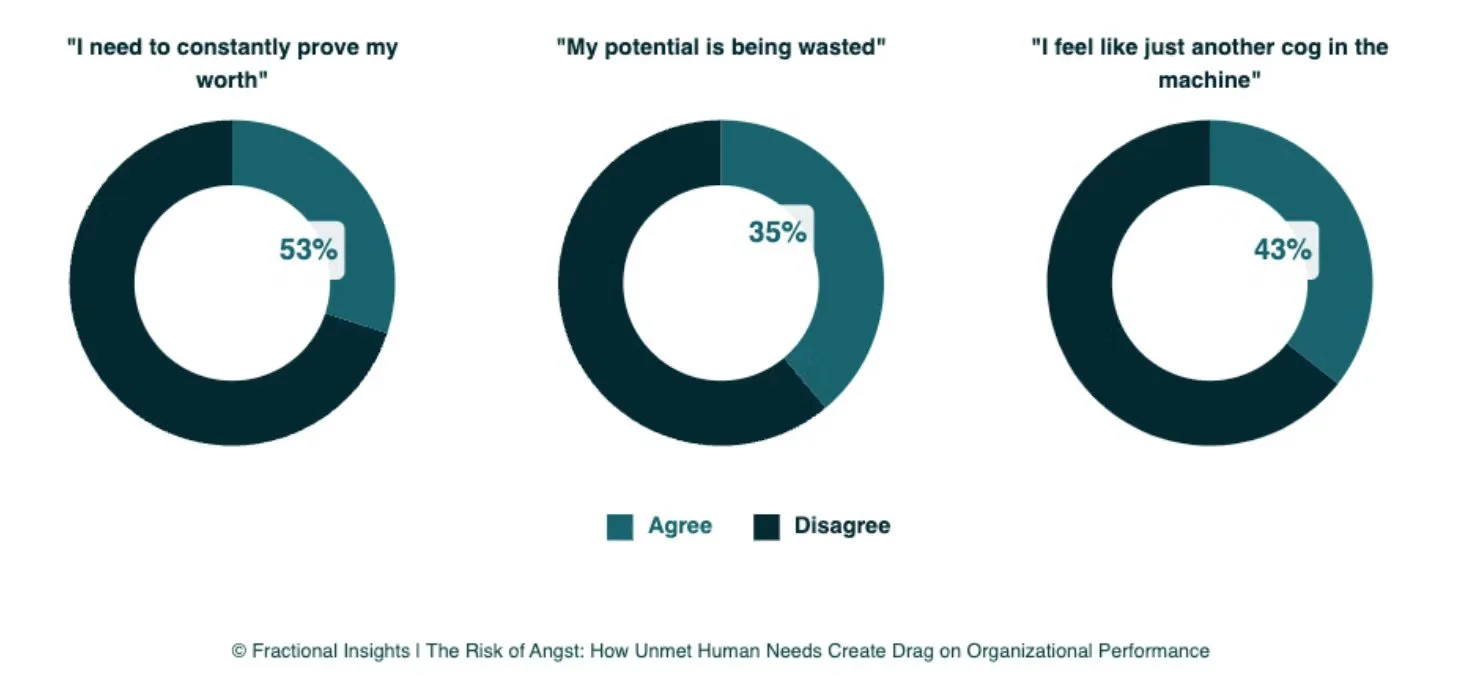
The financial implications are substantial. For a company with 10,000 employees, unaddressed workplace angst translates to an estimated $240-330 million in annual losses through reduced performance, engagement deficits, and talent vulnerability.
A New Lens on Human Capital
Unlike conventional engagement studies that focus on symptoms, our research digs deeper to identify the root psychological causes of workplace underperformance:
We've identified three universal psychological needs that drive all workplace behavior
We've measured how frequently these needs go unmet in modern work environments
We've quantified the performance impact when psychological needs and work design are misaligned
Beyond Traditional Retention Metrics
Perhaps most concerning is what our research reveals about talent risk. Traditional retention metrics are significantly underestimating vulnerability to talent loss, missing what we call the "retention-tension" phenomenon—a dangerous contradiction where employees appear committed while being highly susceptible to poaching.
This hidden vulnerability creates a workforce that stays out of fear rather than loyalty—a ticking time bomb in today's competitive talent landscape.
The Power Distance Effect
Our research uncovered surprising insights about who experiences workplace angst. While demographic factors show little correlation, organizational power emerges as the strongest predictor—with those furthest from decision-making authority experiencing significantly higher levels of distress.
The Competitive Advantage of Alignment
The good news? Organizations that align their human capital strategies with fundamental psychological needs don't just create happier employees—they systematically outperform competitors.
Our research identified several critical practices that significantly reduce workplace angst and drive measurable business outcomes, for example providing transparency on decision-making and resulting impacts on people, offering learning and up skilling opportunities, and connecting people’s contributions to impact. The full report outlines these practices and provides a framework for implementing them in your organization.
The Path Forward
Fractional Insights has pioneered "Psychological Ergonomics™"—a methodology that engineers human capital strategies to reduce angst and drive performance with scientific precision. Just as physical ergonomics optimizes workspaces for our bodies, Psychological Ergonomics™ optimizes work environments for human psychology.
Learn More
The full report, "The Risk of Angst: How Unmet Human Needs Create Drag on Organizational Performance," provides detailed insights, methodologies, and actionable strategies for addressing workplace angst.
